Tuesday, February 28, 2012

Chapter Eight: The Zism and the Dancing Doodles

Note from Rebus: The image of the zism (depicted right) came to Rea in a time when he was at loose ends. After nearly 12 years of devotion to keeping the Biograph open, upon leaving his job as its manager he was on the lookout for something new. Or maybe it was something he had lost along the way. 

Yet, after years of being immersed in a pretend world of movie scenes, rather than seeking enlightenment, or focusing on learning a useful trade, Rea went deeper into living in an imaginary realm. Which led to him making up his own ism. 

*

In the spring of 1983 the Biograph Theatre's owners, based in Georgetown, could see the bad trends from a hundred miles away. The deterioration of the commercial neighborhood surrounding the theater was obvious. Baby boomers in their 30s were moving out of the Fan District. The growing impact cable television was having on repertory cinemas, in general, was depressing. There were other problems,too, including what the owners saw as a bloated payroll.

In May they almost sold their struggling independent twin cinema to a chain. When the potential buyer refused to accept responsibility for all of the Richmond Biograph's debts, the deal fell apart.

Those few days of anxiety-ridden uncertainty, when it appeared everything I'd worked for was about to disappear like a puff of smoke, scared the hell out of me.   

Which made me see that my persona was resting entirely on the platform my peach of a job had provided for me. It was who and what I was perceived as being. I lived it 24-hours-a-day. There was no other job like it in Richmond. Which also meant, one way or another, most of the favors that had tumbled my way since 1972 had traveled across that same platform.   

It was a high-profile position in a rather small world. And, in my tortured frame of mind it was also a trap that had me in its grip. The painful truth that I hadn't been a particularly good manager for most of the previous year also weighed on me. After stewing in my juices for a few weeks, dwelling on such darkly-tinted thinking, I lurched to  a decision -- continuing to be terrified of losing my job was simply intolerable.

Consequently, for the first time, just closing the door and walking away from the Biograph began to seem to be my best option. My divorce had just become final and my then-girlfriend, Tana, thought I had gotten stale keeping the same job too long. In spite of how crazy it seems now, having no plan for how to make a living scared me less than staying on.

Thus, for reasons good and bad and fantasizing I would solve whatever money problems popped up with my willpower, I took the plunge and resigned.

Caught up in a mania, I promptly sat down in my downtown apartment on Franklin Street and created a three-page, hand-lettered resume ... with 'toons for illustrations. Then I mailed off a batch of them to apply for jobs that looked attractive to me. In some cases they just went to organizations I admired, without applying for a particular opening.

Awaiting all the new opportunities, I seriously set about making some new art -- stuff that would have nothing to do with selling classic double features or midnight shows. I worked on depicting what a couple of my childhood recurring dreams looked like. I also tried to do some writing but became frustrated with the process.  

Naturally, it was disappointing when the interviews and offers I was sure would flow my way from sending out those goofy resumes never happened.

At this time I was acting as the art director for Throttle (magazine) and I hosted a weekly show on Color Radio. Neither of those time-eating responsibilities paid a nickel. However, I also sold and produced advertisements for both entities, which did bring in a little money. Very little. So, I began the process of shrinking my lifestyle -- selling off old collectible stuff, cool objects I had acquired in fatter times.

As the summer passed I drew some comic strips, made a series of small paintings featuring Rebus (like the one to the left), and I put together a couple of collages (that I later destroyed). A large abstract painting was also produced (which I still have). In the doing of all that I designed a logo-looking graphic to represent movement through time and dimensions.

With an eye always on sarcasm and mockery I called my new gimmick a “zism,” to label it as the symbol of the last ism, the inevitable final system of beliefs and conclusions that would assimilate all the previous isms in history -- a perfect postmodern ism, as chock-full of mysterious hokum as any of them.

The zism's look was inspired by the 1920s constructivist movement in the USSR and 1930s cartoons, especially those created  by Max Fleischer -- Popeye, Betty Boop, etc. In my view it suggested both structure and spontaneity.

In truth, the zism was a mindless doodle drawing that I played with and refined over time. As I then considered doodles to be my most natural way of drawing that meant the zism was also about truth. The first published zism, along with some gesture drawings of little dancing pairs, appeared on the cover of Throttle's December 1984 issue.  

Eventually, I had to draw zisms on handbills and put them up on utility poles to see what would happen. In the spring of 1985 I posted a series of “Zism” handbills. They featured cartoons, photos, off-the-wall questions and sayings … and zisms. I liked drawing them. The handbill pictured below was No. 2.
In a droll way I thought the twirling symbol, representing anything you wanted it to, was funny.

Funny?

Maybe that was just more proof of how unhinged I was in this period. And, speaking of unhinged, a dislocated ankle put me on crutches and ended the handbill series. It also made me concentrate on writing, again, in the weeks that followed the injury. I designed the first issue of SLANT, a 16-pager. I also made four large collages on plywood panels. The largest of them was installed in the 3rd Street Diner. 

Then, in the spring of 1986, I started stapling issues of SLANT -- this time front-and-back, two-page handbills -- to selected utility poles twice a week.

In part, that was done to protest the City of Richmond’s renewed crackdown on fliers. I also wanted to establish that a periodical’s legitimacy could be in the eyes of the beholder. In the course of that oblique mission I fell in love with publishing. Then SLANT came down off the poles to go through several changes in format over the next eight years, or so.

The doodle-like drawings of couples dancing made a comeback in 1986. By then I had named them Dancing Doodles. They were used to fill the variable small space that remained open at the end of the pasting up of an issue of SLANT. The space to be filled was usually about an inch or an inch-and-a-half tall.

In printer's parlance the Dancing Doodles were used as dingbats. Drawing them was the fun part of the paste-up chore I always saved for last. They were drawn quickly without a plan; each mark was simply a reaction to the last. Those little Dancing Doodle drawings were further attempts at depicting structure and spontaneity moving in harmony -- sort of like what a good jam session is made of.

After a year or so, I stopped putting the Dancing Doodles in SLANT, as the 'zine matured and got tighter in its layout. I was surprised but pleased when I got some complaints.

In the mid-1990s I made a few paintings of dancing couples, maybe a half-dozen. Again, I was thinking about the righteousness of doodles. These pieces were larger and more involved than what had come before. A few prints of them sold, cheaply, then I put them on the back burner again. Dancing Doodle No. 3 (approximately 8" by 10"), seen below, was part of that series.

The Sound

 The handbill in this story

In the spring of 1984, I ran for public office. In case the Rea for City Council campaign doesn’t ring a bell, it was a spontaneous and totally independent undertaking. No doubt, it showed. Predictably, I lost, but I’ve never regretted the snap decision to run, because the education was well worth the price.

In truth, I had been mired in a blue funk for some time prior to my letting a couple of friends, Bill Kitchen and Rocko Yates, talk me into running, as we played a foozball game in Rockitz, Kitchen's nightclub. Although I knew winning such an election was out of my reach, I relished the opportunity to have some fun mocking the system. Besides, at the time, I needed an adventure.

So it began. Walking door to door through Richmond’s 5th District, collecting signatures to qualify to be on the ballot, I talked with hundreds of people. During that process my attitude about the endeavor began to expand. People were patting me on the back and saying they admired my pluck. Of course, what I was not considering was how many people will encourage a fool to do almost anything that breaks the monotony.

By the time I announced my candidacy at a press conference on the steps of the city library, I was thoroughly enjoying my new role. My confidence and enthusiasm were compounding daily.

On a warm April afternoon I was in Gilpin Court stapling handbills, featuring my smiling face, onto utility poles. Prior to the campaign, I had never been in Gilpin Court. I had known it only as “the projects.”

Several small children took to tagging along. Perhaps it was their first view of a semi-manic white guy — working their turf alone — wearing a loosened tie, rolled-up shirtsleeves, and khaki pants.

After their giggling was done, a few of them offered to help out. So, I gave them fliers and they ran off to dish out my propaganda with a spirit only children have.

Later I stopped to watch some older boys playing basketball at the playground. As I was then an unapologetic hoops junkie, it wasn’t long before I felt the urge to join them. I played for about 10 minutes, and amazingly, I held my own.

After hitting four or five jumpers, I banked in a left-handed runner. It was bliss, I was in the zone. But I knew enough to quit fast, before the odds evened out.

Picking up my staple gun and campaign literature, I felt like a Kennedyesque messiah, out in the mean streets with the poor kids. Running for office was a gas; hit a string of jump shots and the world’s bloody grudges and bad luck will simply melt into the hot asphalt.

A half-hour later the glamour of politics had worn thin for my troop of volunteers. Finally, it was down to one boy of about 12 who told me he carried the newspaper on that street. As he passed the fliers out, I continued attaching them to poles.

The two of us went on like that for a good while. As we worked from block to block he had very little to say. It wasn’t that he was sullen; he was purposeful and stoic. As we finished the last section to cover, I asked him a question that had gone over well with children in other parts of town.

“What’s the best thing and the worst thing about your neighborhood?” I said with faux curiosity.

He stopped. He stared right through me. Although I felt uncomfortable about it, I repeated the question.

When he replied, his tone revealed absolutely no emotion. “Ain’t no best thing … the worst thing is the sound.”

“What do you mean?” I asked, already feeling a chill starting between my shoulder blades.

“The sound at night, outside my window. The fights, the gunshots, the screams. I hate it. I try not to listen,” he said, putting his hands over his ears to show me what he meant.

Stunned, I looked away to gather my ricocheting thoughts. Hoping for a clue that would steady me, I asked, “Why are you helping me today?”

He pointed up at one of my handbills on a pole and replied in his monotone. “I never met anybody important before. Maybe if you win, you could change it.”

Words failed me. Yet I was desperate to say anything that might validate his hope. Instead, we both stared silently into the afternoon’s long shadows. Finally, I thanked him for his help. He took extra handbills and rode off on his bike.

As I drove across the bridge over the highway that sequesters his stark neighborhood from through traffic, my eyes burned and my chin quivered like my grandfather’s used to when he watched a sad movie.

Remembering being 12 years old and trying to hide my fear behind a hard-rock expression, I wanted to go back and tell the kid, “Hey, don’t believe in guys passing out handbills. Don’t fall for anybody’s slogans. Watch your back and get out of the ghetto as fast as you can.”

But then I wanted to say, “You’re right! Work hard, be tough, you can change your neighborhood. You can change the world. Never give up!” During the ride home to the Fan District, I swore to myself to do my absolute best to win the election.

A few weeks later, at what was billed as my victory party, I, too, tried to be stoic as the telling election results tumbled in. The incumbent carried six of the district’s seven precincts. I carried one. The total vote wasn’t even close. Although I felt like I’d been in a car wreck, I did my best to act nonchalant.

In the course of my travels these days, I sometimes hear Happy Hour wags laughing off Richmond’s routine murder statistics. They scoff when I suggest that maybe there are just too many guns about; I’m told that as long as “we” stay out of “their” neighborhood, there is little to fear.

But remembering that brave Gilpin Court newspaper boy, I know that to him the sound of a drug dealer dying in the street was just as terrifying as the sound of any other human being giving up the ghost.

If he's still alive, that same boy would be older than I was when I met him. The ordeal he endured in his childhood was not unlike what children growing up in any number of the world’s bloody war zones are going through today. Plenty of them must cover their ears at night, too.

For the reader who can’t figure out how this story could eventually come to bear on their own life, then just wait … keep listening.

-- 30 --

All rights reserved by the author. 

Monday, February 27, 2012

The Brileys

Note from Rebus: Now it's time for this wandering collection of stories to leave the beaten path of hippie days remembrances. This bizarre story is a pip.

Richmonders experienced an abrupt change in the standards by which news was gathered and presented 28 years ago.

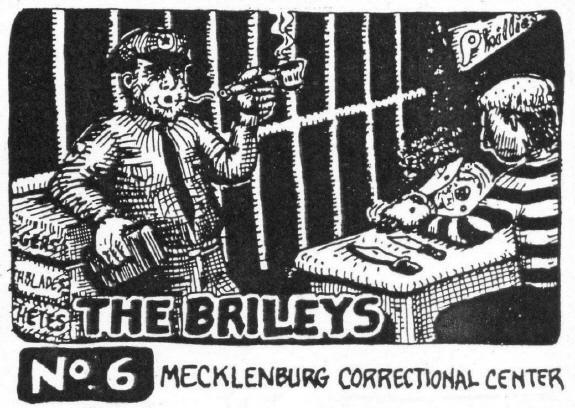
Having terrorized the town with a series of grisly murders five years before, on May 31, 1984, brothers Linwood and James Briley led the largest death-row jailbreak in U.S. history. In all, six condemned men flew the coop by overpowering prison guards, donning the guards’ uniforms and creating a bogus bomb-scare to bamboozle their way out of Virginia’s supposedly escape-proof Mecklenburg Correctional Center. While their four accomplices were rounded up quickly, the brothers Briley remained at large for 19 days.

The FBI captured the duo at a picnic adjacent to the garage where they had found work in Philadelphia. Linwood was subsequently electrocuted in Richmond on Oct. 12, 1984; likewise, James on Apr. 18, 1985.

While the Brileys were on the run and for some time afterward the media coverage, both local and national, was unprecedented. During the manhunt the Brileys-mania led to stories about them being spotted simultaneously in various locations on the East Coast from North Carolina to Canada. When I noticed kids in the Carytown area were pretending to be the Brileys, and playing chasing games accordingly, well, that was just too much.

My sense of it then was the depraved were being transformed into celebrities so newspapers and television stations could sell lots of ads. Once they were on the lam, if it came to making a buck, it didn’t seem to matter anymore what the Brileys had done to be on death row.

“OK,” I said to a Power Corner group in the Texas-Wisconsin Border Cafe on a mid-June evening, “if the Brileys can be made into heroes to sell tires and sofas on TV, how long will it be before they're on collectable cards, like baseball cards? (or words to that effect).” To illustrate my point I grabbed a couple of those Border logo imprinted cardboard coasters from the bar and drew quick examples on the backs, which got laughs.


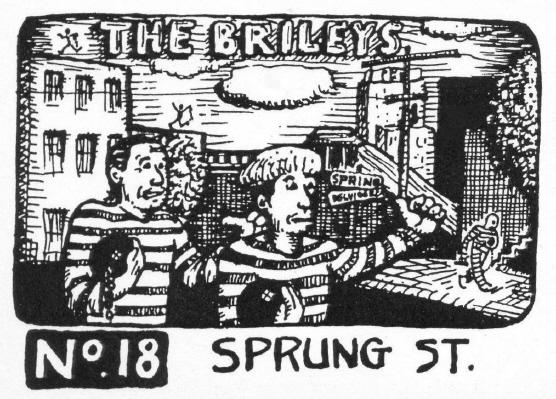
Later at home, I sat down at the drawing table and designed the series of cards. To avoid race humor entirely I used a simple drawing style that assigned no race to the characters. The sense of humor was sardonic and droll. I elected to run off a hundred sets of eight cards each, which were put into small ziplock plastic bags, with a piece of bubble gum included for audacity's sake. I figured to sell them for $1.50 a set and see what would happen.

Traveling about the Fan District on my bicycle it took about three days to sell the first press-run out of my olive drab backpack. New cards were designed, more sets were printed, more plastic bags, more bubble gum. A half-dozen locations began selling “The Brileys” on a consignment basis.

Sales were boosted when the local press began doing stories on them. For about a week I was much-interviewed by local reporters. The Washington Post ran a feature on the phenomenon and orders to buy card sets began coming in the mail from Europe.

Reporters called me for easy quotes to fill articles on death penalty issues, as if I was an expert on the subject. That I was opposed to the death penalty seemed to strike them as odd. Moreover, finding myself in a position to goose a story that was lampooning the overkill presentation of the same press corps that was interviewing me was delicious fun. In the midst of a TV news story I announced that T-shirts commemorating the Brileys' 1984 Summer Tour were on the way.

Apart from my efforts, the hated Briley brothers’ chilling crime spree and subsequent escape inspired all sorts of lowbrow jokes and sick songs, and you-name-it, which did indeed fan the flames of racial hate in Virginia.

Naively, I felt no connection to that scene until a stop at the silk screen printer’s plant suddenly cast a new light on the fly-by-night project that summer's effort was. Walking from the offices to the loading dock meant passing through a warehouse full of boxes, stacked to the ceiling. Suddenly, I was surrounded: Four or five young men closed in and cornered me.

Some of them, if not all, had box cutters in their hands; all of them were definitely black. At that moment I felt whiter than Ross Mackenzie. Tension filled the air when their spokesman asked if I was the man behind the cards and T-shirts.

As it was not the first time I’d been subjected to questions about the cards, I quickly asked if any of them had seen the cards, or had only heard about them. As I suspected, they hadn’t seen them.

Luckily, I had a pack in my shirt pocket, which I took out and handed to the group’s leader. As he studied them, one by one, his cohorts looked over his shoulder. I explained what my original motivation had been in creating the cartoons. No one laughed but the spell was soon broken. I let them keep the cards.

Later I was in a drug store, restocking one of my dealers for the cards, when a white lady with blue hair approached me. She worked there and had seen the cards, which she found unfunny. She told me her husband was on the crew that had cleaned up the crime scenes after some of the murders. Then she said if I was going to profit from it, I should be man enough to hear her out.

So, I did. She gave me specific details. It was mostly stuff I had known, or suspected, but the way she told it was brutal.

At this point the success of my absurd art project seemed to be going sour. I got a call from a reporter asking me what I had to say about Linwood Briley having made some disparaging remark about my cards. I got peeved and asked the scribe what the hell anybody ought to care about what such a man has to say.

Like it or not, I had become a part of what I had been mocking in the first place.

Shortly afterward the cards and T-shirts were withdrawn from the market. Unfortunately, without the context of the 1984 news stories being fresh the humor aspect of the cards is somewhat arcane now, because all the images were based on details from those well reported stories.

Three years later I was in the Bamboo Cafe, standing at the bar at Happy Hour, having a beer and talking with friends about sports (probably). A middle-aged man I didn’t know stepped my way to ask furtively if I was the guy who “drew those Briley cards.”

After I said “yes,” and introduced myself, he asked me a few questions about the cards. Then he spoke in a hushed tone, saying something like, “What about those missing cards?”

“Missing cards?” I returned. “Are you asking why I skipped some numbers?

He nodded and reached in his pocket to pull out a full set of The Brileys, still in its original plastic bag.

Wanting to end the conversation quickly -- that he had the cards with him was too strange for me -- I told him the simple truth with no jokes: “OK. First, I wanted to imply there was a vast series out there, without having to create it. Then, I wanted the viewer to maybe imagine for himself what the other cards might be.”

The collector put his cards back in his pocket. He stepped away, plainly disappointed with my easy answer, which gave him no dripping red meat to savor. That night the truth without hype was of little use to my public, such as it was.

-- 30 --

Sunday, February 26, 2012

Fan City Trivia Card Collection

The Fan City Trivia Card Collection (1984), a set of 12 cards, followed The Brileys later the same year. Like all five of my card sets (to date) this one came packaged in a small transparent Ziplock bag. After the Brileys series I didn’t include bubblegum, again.

Stemming from The Brileys card set’s notoriety, I was enthusiastic about finding more ways to sell my cartoons directly to the public. As Trivial Pursuit was a popular game then, I decided to see if I could play with that trend.

With my second effort at producing collectible cards, the back of each card had a trivia question. On the reverse side the answer and an illustration appeared. I used the same network of a dozen or so retailers that I had created to market The Brileys cards.

A year later that same basic list of locations would be what I used to launch The SLANT. The first two issues of The SLANT in 1985 were 16-pagers that sold for a quarter per copy. But the history of that periodical is fodder for another project. Meanwhile, here are the questions and answers for Fan City Trivia:

Card No. 1: At the 1982 "Atomic Cafe" handbill trial, who was the art professor who testified as to the difference between random soup cans on the street and Warhol's art?
Answer: [Jerry] Donato

Card No. 2: What year did the experts change Grace Street to allow for two-way traffic?
Answer: 1981
Card No. 3: On Mar. 19, 1974, Franklin St. was witness to a riot in which 17 were arrested. What campus fad triggered the melee?
Answer: Streaking

Card No. 4: Billy Burke's late-'70s, Kennedy assassination newsletter was named after a place. What was it called?
Answer: The Grassy Knoll Gazette

Card No. 5: Name the [expatriate] jazz guitarist who wrote a song called "Grace Street" and recorded it on the Kicking Mule label.
Answer: Duck Baker

Card No. 6: Name the erstwhile and notorious umpire who called most of the Fan League's softball games in 1977 and hasn't been seen since.
Answer: Leo Koury
Card No. 7: The last Sal Special was burned to a crisp. Name the eatery that served [that signature dish] until a summer blaze in 1983.
Answer: The Capri
Car No. 8: With the heat lightning flashing on a 1970 summer night, Bruce Springsteen’s group knocked ‘em dead on top of a downtown parking deck. Name the band.
Answer: Steel Mill

Card No. 10: Who plays lead guitar (and the sax) for the Memphis Rockabilly Band?
Answer: Bill Coover
Card No. 11: On an Indian Summer day in 1968, the FBI seized a Yippie petition from what Ryland Street head-shop?
Answer: The Liberated Area

Card No. 12: On April 2, 1982, the Cha-Cha headlined a mud-wrestling bout. Name the two contestants.
Answer: Dirtwoman vs. Dickie Disgusting

Card No. 13: Name the fashionable, underground bi-weekly that documented the campus scene of RPI’s last gasp.
Answer: The Sunflower

The Fan City Trivia Card Collection edition didn't take off anything like the previous set had. On top of that, I wasn’t happy with all of the art. Plus, I was pissed off at myself for one particularly grievous careless mistake I had made in the copy of a question -- I spelled “expatriate” wrong.

Such is the problem with working alone. This was the beginning of the time in which I realized that having a staff of smart proofreaders, like I had enjoyed all that time at the Biograph, had been more valuable than I had ever given it credit for. 

When I stopped selling the Fan City Trivia cards, not all that long after their release, I did so with the idea I would make a few new cards to replace the ones that needed it. Then I would re-release the deck, maybe with a total of 15 cards.

It never happened, but I did recycle two of the same characters into a subsequent edition of cards called SLANT Legends (1993), which was the third of the five sets I have produced.

Walking Songs

Note from Rebus: Rea has written a handful of songs. For the most part, nobody has ever heard them. This is the first time he's even put the words to one of them in front of an audience. When I told him it's good medicine to let stuff like this go, he disagreed obliquely and told me he knows good medicine when he smokes it.

The name Detached first came to Rea as the name for a one-time-only magazine project in 1981. It was to be a collection of comix-style art created by several artists. It was going to have a little flexi-disc with music and comedy on it. Now such a concept might be called a book-zine, or something like that. Although quite a bit of material was created and submitted, this was one of those projects that got away from him in a time when a lot of things slipped away. 

Consequently, it was never produced, although some of the material and ideas made their way into issues of SLANT later on ... but that's another story.

A few years down the road Detached, as a title, became the name for a song he used to whistle and sing to himself. Rea used to whistle a lot, especially along with music when he was making art, or pasting up flats for a printer. Now he hardly ever does. 

*

Detached, as seen below, was written as a song in 1985. It came to me during a walk. For decades I used to make up songs in the course of solitary walks. The cadence of my steps would serve as the beat, as I'd sing them softly to myself or just in my head.

Then I'd almost always forget the new song when I finished the walk. Sometimes it was quite frustrating. Other thoughts, like solutions, inventions, schemes and so forth, they would stick long enough to be written down when I got home. But most of the time these songs refused to be gathered that way.

They were like dreams that faded away as I sat up in bed in the morning and put my feet on the floor. And, like those rare dreams that would remain vivid into the day, only a few of my walking songs stayed assembled in my head after the walking/waking. 

In the case of Detached, as seen below, the tune and the words have become as familiar to me as characters in a movie I've seen many times. 

With regard to walking, many times I've put extra trust in an idea that came to me while walking alone. So, this little string of words is part of what the title to this collection of stories is about.
D E T A C H E D

I want to thank you pal
for helping out
While I went crazy.

It wasn’t all fun
It just had to be done.

Beauty mark and a ponytail
Hey!
Your check’s in the mail.

De-tached.

When I could close my eyes
And float away
Life seemed so easy.

Watching tides of fashion
Riding waves of passion.

Smokey edges of a photograph
Yo!
We just had to laugh.

De-tached.

Saturday, February 25, 2012

Fan District Bar Obits

Texas-Wisconsin Border Café

-- Originally published by Richmond.com in 1999

In 1982 three adventurous friends trusted their instincts and put together the Texas-Wisconsin Border Café, a quirky Fan District watering hole known affectionately as “The Border.”


Owners Jim Bradford (depicted above), Donna Van Winkle and Joe Seipel were rewarded with an immediate following. It evolved into an institution known widely for its wacky interior and its diverse crowd; a place where blue collars, white collars and no collars got along famously.

When word got out in early March the Border was being sold, old customers and ex-staffers began making pilgrimages to the place for one last drink, one last connection to a piece of their youth. Although it had been rumored the Border was for sale for some time, what isn’t these days?

When Bradford -- a tireless photo-realistic painter with a curmudgeon’s sense of humor -- died in the summer of 1997, well, the future of the restaurant became much more complicated. Of the three owners, Jim had surely been the one who spent the most time bellied up to the bar, overseeing operations.

After managing the restaurant in its salad days, Van Winkle had gone to law school, become an attorney, and moved to Fredericksburg. Fifty miles is a tough commute for a late-afternoon beer.

That left Seipel, chairman of VCU’s sculpture department, to hold down the happy hour fort in the section of the restaurant known as the Power Corner. Although Seipel’s talent for convivial conversation is considerable, he had taken on time-consuming responsibilities over the years; fatherhood not the least of them.

So, it was time to turn the page. On March 14, the last night of the original ownership’s watch, a bagpiper played “Amazing Grace” to close the Border down. After playing a while for the crowd on hand he marched out the door, bagpipes caterwauling passionately, and it was done.

The scene brought to mind filmmaker Luis Bunuel’s apt comment in his autobiography, My Last Sigh, about a good bar being like a chapel. No doubt, most who were there for the piper’s last mournful note took with them a strong sense of that sentiment.

Then new owners decided to honor a date the old owners had made with Burnt Taters for a March 26 CD release party. That meant keeping the business open under the old banner for a few more days and putting off the renovations. As it turned out, the delay set the stage for quite a finale.

What followed was an auction event on the actual last night of operation as the Texas-Wisconsin Border Café. At six o’clock Page Wilson with Reckless Abandon gave the makeshift stage in the front of the room over to the selling off of the bar’s wild and eclectic collection of wall decorations and art-like objects. They pulled down the framed pictures, the stuffed animal heads, the signs, and you name it. What went on was part wake, part fund-raiser, part souvenir-grab and all party.

The bidding at times resembled a feeding frenzy, as people climbed over one another to throw three figures at stuff, some of which wouldn't go for five bucks at a yard sale. The crowd cheered as each bid drove the price higher.

One rather attractive young woman gladly paid hundreds of dollars for a stuffed squirrel’s butt. A roar went up as she outbid her rivals and everyone ordered another round. The more absurd the prices got the more fun was being had. Since the money raised from the auction all went to the Bradford Scholarship Fund at VCU, more than $10,000, the harm couldn’t be found.

The Border, a happening unique in an age of conformity, will be missed. Don’t expect it to happen again.

*

Soble’s

-- Originally published by Richmond.com in 2000

Soble’s, home of “the world-famous bacon cheeseburger” for 22 years, is no more.

Paul Soble and his partner, Bruce Behrman, have sold the well-known Fan District restaurant to a group that plans to open a new restaurant under the name, “The Devil’s Kitchen.”

Soble’s, Part One, lasted ten years (1977-87) at 2526 Floyd Avenue in what had previously been the location of Cavedo’s, a traditional neighborhood drug store with a classic soda fountain. Part Two saw the restaurant lose its lease, pack up its patio, and move one block to the south - 2600 West Main Street.

Soble’s had a feel to it that was reminiscent of traditional watering holes in large cities on the eastern seaboard. Its elegant back bar was cluttered with memorabilia that included hundreds of photos of regulars and popular culture souvenirs that documented a generation’s after-dark highlights and next-day hangovers.

The mirrors were covered with Elvis kitsch, dog-eared tickets from NRBQ concerts, High on the Hog backstage passes, postcards featuring shapely derrieres, and silly bumper stickers with slogans such as, “bad cop - no doughnut.”

Perhaps the peak of Soble’s popularity was in the mid-‘80s, when an every-other-Monday jam session evolved into a scene that had a touch of magic. It came to be known as the “Blue Monday Jam.”

As the summer of 1986 wore on, the crowds for the impromptu show began to fill the restaurant and overflow onto the patio and into Floyd Avenue. Jimmy Maddox, a vocalist who accompanied himself on piano, served as organizer and host for shows that included the best musicians in town on a given Monday.

Other clubs tried to copy the concept and attempted to set up nights for jam sessions. None of them were ever able to duplicate the scene that naturally formed in Soble’s.

Behrman confirmed that indeed he saw the Blue Monday Jam as a high water mark in popularity for the restaurant. But he laughed at the idea that the live music crowds of those Monday nights spent a lot of money.

Still, that rowdy scene was part of why Soble’s became a headquarters for a certain ilk. It now joins the Texas-Wisconsin Border Café and John & Norman’s as noteworthy Fan District restaurants to cash in their chips within the last year.

According to Vaughn Turner, a bartender for many years at the Border, the Devil’s Kitchen will serve a bacon cheeseburger of sorts. He also indicated that hot sauces, made on the premises, will be featured in the new operation. Turner is one of three partners involved in the venture.

While there to check out the changes underway, I looked for a bullet hole in the back bar that had been put there during a 1987 holdup, shortly after the move from Floyd to Main. One of the robbers fired a shot at Soble that he was purported to have dodged. I couldn’t find the hole; somebody must have fixed it. It’s hard to imagine Paul ever moving that fast again.

Perhaps it was time to make a change. As far as why he and Soble sold the business, Behrman said, “We both got tired of it and wanted to do some other things. Business was okay.”

Soble’s is on a short list of restaurants that gets, or deserves, an obituary.

*

Update Note: Paul Soble died on July 27, 2000.

*

Chiocca’s Park Avenue Inn

-- Originally published by Richmond.com in 2004

On Monday, Frank Chiocca stood tending bar for his last shift. As he answered a question from a customer the phone rang; another old friend was calling to pay his respects. With the sun setting on what was a crisp autumn day Chiocca was reflective, yet upbeat, in the midst of his familiar five o'clock crowd for the last time.

Chiocca's Park Avenue Inn opened for business on June 18, 1964. It closed for good on November 29, 2004.

According to Chiocca a 1964 bottle of Richbrau, which was then brewed and bottled about a half-mile from his Fan District location, cost a quarter. He chuckled, "Forty years! I didn't have two nickels to rub together when I got here."

To say Frank Chiocca, 79, has the food-and-drink biz in his blood is a bit of an understatement. After returning to Richmond from service in the Italian army during World War I, his father, Pietro Chiocca -- whose two older brothers were already running a restaurant at 812 W. Broad Street called Jimmy's -- became a partner in Silvio Funai's restaurant. The building at 327 E. Franklin St., which no longer exists, had previously been a public library. In 1937 "Pete" Chiocca bought Funai out and renamed the place Chiocca and Son.

Before they left to serve in the American armed forces during World War II, Pete's boys -- Andrew, Joe, Mario and Frank -- all worked in his restaurant, which was across the street from the Richmond Newspapers building.

In 1947 Joe opened his own eatery at 2915 W. Cary St. (in the building that now houses The Track); he called it Chiocca's. In 1952 brother Mario followed suit by opening his version of a Chiocca's at 425 Belmont Ave. His children, Tim and Carla, still operate that basement tavern today, in much the manner it has always been run.

In 1961 Pete Chiocca closed the original downtown Chiocca's. Using the typewriter with which he had created the daily menus for years, Frank then put together a few recollections of his father's place to help columnist Charles McDowell with a piece he wrote paying tribute to the passing of a favorite haunt. According to McDowell's account, Frank's history recalled, "... the prohibition days, the bawdy girls who would occasionally saunter in to catch the eye of a medical student, a lawyer, an artist, musician, and perhaps even a newspaper man. ...and the ever-present gas pilot light at face level near the tobacco case, for lighting one's cigar or cigarette."

Chiocca's Park Avenue Inn was known for its time-capsule atmosphere and its made-to-order sandwiches; the signature sandwich was called "the Masterpiece." It featured an anchovy sauce based on Frank's mother's recipe. Watching his hands carefully constructing a sandwich and arranging the presentation on the plate was always worth studying; he was a polished craftsman.

In recent years his shrinking customer base was made up mostly of young families from the surrounding blocks who eschewed fast food, and graying beer aficionados who grew up in that same area. Now those loyal customers have lost an authentic connection to a sepia-toned time when the Fan District was dotted with Ma and Pa restaurants and small markets.

Moreover, the list of forgettable dives and pretentious hash houses that have come and gone in the Fan during Frank Chiocca's steady 40-year-run is too long for this limited space.

“All things come to an end,” Chiocca shrugged. “Forty years; it’s been a good run.”

-- 30 --

Friday, February 24, 2012

The Last High on the Hog

Memphis Rockabilly Band onstage in 2006

Note: This piece was first published by Brick Weekly in 2007.


Due to the intrusion of an all-day downpour, last year’s edition of High on the Hog (on Oct. 7, 2006), No. 30, was a soggy affair. Two of the bands scheduled couldn’t play under the circumstances. Yet, in spite of the stormy weather, the Bopcats and the Memphis Rockabilly Band performed using a scaled down sound system. Tarps were lashed to the sides and back of the stage to block the wind-driven rain.

A few party stalwarts danced in the mud with umbrellas. The show went on … but perhaps for the last time.

“It was a Nor’easterner that settled over Richmond,” said the longtime director of matters musical, Chuck Wrenn. “We’ll see what the future brings.”

Meanwhile, there certainly will be no High on the Hog 31 this year.

So, the director of matters porcine, Larry Ham, won’t be slathering his Carolina red vinegar basting sauce over slow-cooking pork this Saturday in Libby Hill Park. Moreover, it seems likely that High on the Hog—which for three decades has served a generation as a reliable reunion party—has probably happened for the last time.

The heavy losses sustained from last year’s fizzler meant the handful of friends/neighbors who have staged and financially backed HOTH since its inception took a bath in red ink ... the rainy day fund was wiped out.

Going back to HOTH’s origins, other than Ham, among Wrenn’s chief co-conspirators have been: Bobby Long, Dave O’Kelly, John Cochran, Randy Smith and Steve McKay. For such veterans last year’s weather had to bring to mind another rainy day, 26 years before. 1980 was the year they significantly enlarged the plan for what had originally been a small annual neighborhood party.

Three rousing rock n’ roll bands played on a flatbed trailer in the cobblestone alley behind Wrenn’s 2808 East Franklin Street back yard for what was the then-largest HOTH crowd ever.

Yet, this was a time when one couldn’t get a permit from the proper authorities for such an event. Amplified Rock music simply wasn’t allowed at outdoor shindigs in Richmond, most especially on public property. For whatever reason the cops on the beat chose not to bust it.

When it suddenly began raining, rather than lose momentum by shutting off the electricity and clearing the stage—to wait out the downpour—Wrenn broke out his staple gun and large rolls of heavy-gauge transparent plastic. With the help of volunteers an awning was hastily improvised to keep the rain off the stage. A portion of the yard closest to it was also protected, somewhat.

Then, with the electric guitars of Don’ Ax Me ... Bitch wailing in defiance of the chilly rainstorm, the sense of common purpose felt by those dancing in the mud was unforgettable. The full potential of live rock n’ roll music to simultaneously express both lamentation and celebration was realized.

In 1983 HOTH had outgrown its alley venue, so it shifted gears and moved into the park across the street. The throwdown even went legit. Subsequently, HOTH’s rollicking success and noteworthy lack of trouble planted the seeds for Jumpin’ in July, Friday Cheers and the outdoor music festivals that have blossomed since.

Countless celebrations and festivities have taken place in Libby Hill Park since its original days of being named Marshall Square, after Supreme Court Chief Justice John Marshall. Following the Civil War the name was changed to Libby Hill Park, after Luther Libby who lived adjacent to the park. Libby is remembered by history buffs for his nearby warehouse that was used by the Confederacy as prison during the Civil War.

HOTH parties, Frisbee-golf games and inner tube rides down snow-covered slopes aside, my own most vivid recollection of that park comes from a late afternoon in the early-80s with a girlfriend. For the benefit of my zoomed-in Super 8 lens, she was doing cartwheels, landing smoothly on her hands, then feet, then hands. As I panned to follow her, my camera angle had the shimmering light on the river in the background.

The HOTH record for beer sales on a Saturday afternoon still stands at 209 kegs; it was some time in the early ‘90s, according to Chuck. At its peak, it took some 350 volunteers to chop the pork, serve the beer, tend the stage, etc. Each year volunteers got a new HOTH T-shirt for their trouble; extras were sold to the public. There have been 25 different models.

What was a beloved local gospel group, The Silver Stars, holds the record for most HOTH appearances with 10 (1987-‘96). The Memphis Rockabilly Band played the gig seven times (1980, ‘81, ‘84-‘87, ‘06).

“The Silver Stars, we got every year we could ... until they died,” Wrenn recalled.

What were locally-based bands with multiple appearances include: The Bopcats, The Good Humor Band, Billy Ray Hatley’s bands, Page Wilson with Reckless Abandon and The Wall-O-Matics. Maybe the three most noteworthy national acts were: Billy Price and the Keystone Rhythm Band in ‘83 and ‘85; NRBQ in ‘87; Marcia Ball in ‘01.

Presented with the prospect that HOTH has run it course, a smiling Chuck Wrenn offered familiar advice, “Don’t forget to have a good time.”

Those coveted laminated backstage credentials, which meant free beer to the wearer, will probably be selling on eBay soon. Who knows what T-shirts will eventually be worth?

Appropriately, as it stands now, the last band to perform was the impeccably authentic Memphis Rockabilly Band. Although it was unplanned, they were the perfect act to play an encore for 30 years of smiles ... one last fast-dance in the mud.

*   *   *

All rights reserved.

Thursday, February 23, 2012

Wednesday, February 22, 2012

How About 139 Worthwhile Movies?

Favorite Films from Biograph Times


Why another list of old movies?

My lofty hope is that a reader might be persuaded to take a chance on one or two on this list, titles they've previously overlooked or forgotten about. In other words, once a know-it-all promoter of supposedly gourmet films, always such. It can’t be helped.

You see, I spent so many pleasant hours in my office sanctuary at the Biograph, reading about old movies, choosing double features and writing film notes that the urge to promote what I believe to be worthwhile flicks is still irresistible. When I see a good one on Netflix, these days, I can’t resist urging friends to check it out.

Why 139 movies?

Needed to pick a number, so this makes one film for each month I worked at the Biograph, from December 1971 (two months before it opened) through June 1983 (when I resigned). The titles on this list all played at the Biograph during my stint as its manager. So this isn’t the same thing as a list of my all-time favorites, which would include lots of movies that never played the Biograph.

Hopefully, this particular list represents a fair overview of the range of movies that were staples at art houses and revival theaters during what was the Golden Age of Repertory Cinema. Let’s say that was from 1966, or so, through about 1981 -- roughly, a decade-and-a-half.

And, of course, this list provides a handy source of movie trivia. With foreign language films, in most cases, I’ve used the convenient translation for the title. Exceptions to that rule were made when the foreign film is better known in this country by its original title. Like all the favorite films lists I’ve made, this one represents my favorites today.

So, some of the movies I might have liked a lot 30 or 35 years ago, that now seem less worthy, didn’t make the cut in 2012. As this chapter was compiled and crafted several changes from the first draft were made. Note: All favorites lists must be obedient to the mood of the moment.

*

Title, (Release Year), * Indicates a Richmond Premiere

"The African Queen" (1951): Color. Directed by John Huston. Cast: Humphrey Bogart, Katharine Hepburn. Note: With WWI reaching a German colony in Africa, salty boat captain Charlie and prim missionary Rose are thrown together for a wild ride.

"Aguirre: The Wrath of God" (1972)*: Color. Directed by Werner Herzog. Cast: Klaus Kinski, Ruy Guerra, Helena Rojo. Note: A bizarre but fascinating look at accumulating madness, Conquistador-style, in search of a dream … by way of a river of danger.

"Alfie" (1966): Color. Directed by Lewis Gilbert. Cast: Michael Caine, Shelly Winters. Note: Set in swinging ’60s London, narrator Alfie tells the story of his convenient affairs of the heart. It’s the story of a charming young cad, constantly on the make.

"All About Eve" (1950): B&W. Directed by Joseph L. Mankiewicz. Cast: Bette Davis, Anne Baxter, George Sanders. Note: Bette is at her bitchy best in this peek behind Broadway’s elegant curtains. Marilyn Monroe as the quintessential ditz sparkles.

"Amarcord" (1974)*: Color. Directed by Federico Fellini. Cast: Bruno Zanin, Magali Noël. Note: A nostalgic but fanciful glance back at growing up in a small Italian port, with its eccentric townsfolk, during the era of Fascist rule before WWII.

"American Graffiti" (1973): Color. Directed by George Lucas. Cast: Richard Dreyfuss, Ron Howard, Candy Clark. Note: A wistful glance at choices made in the process of coming of age in pre-JFK assassination times. The oldies soundtrack works to perfection.

"The Apprenticeship of Duddy Kravitz" (1974)*: Color. Directed by Ted Kotcheff. Cast: Richard Dreyfuss, Micheline Lanctôt, Jack Warden. Note: Pushy, social-climbing Duddy is in an awful hurry to become a player, a somebody — a Boy Wonder.

"Bang the Drum Slowly" (1973): Color. Directed by John D. Hancock. Cast: Robert De Niro, Michael Moriarty, Vincent Gardenia. Note: A genuine oddity — a good movie about pro baseball players that even viewers who don’t care about baseball can love.

"Battle of Algiers" (1966): B&W. Directed by Gillo Pontecorvo. Note: This account of the nasty tactics employed by both hardheaded sides during the Algerian revolution is part suspenseful documentary, part staged flick. It will tattoo your mind.

"Bell Du Jour" (1967): Color. Director: Luis Buñuel. Cast: Catherine Deneuve, Jean Sorel, Michel Piccoli. Note: Beautiful Severine loves her successful husband. With him she’s frigid. Her kinky fantasies lead her to the oldest profession … only by day.

"Between the Lines" (1977)*: Color. Directed by Joan Micklin-Silver. Cast: John Heard, Lindsay Crouse, Jeff Goldblum. Note: The anti-establishment era in which an alternative newspaper was hip is winding down. The quirky staff wonders, what next?

"Black Orpheus" (1959): Color. Directed by Marcel Camus. Cast: Breno Mello, Marpressa Dawn. Note: This utterly charming film is the retelling of a Greek myth, set during Carnival in Rio de Janeiro. It won the 1960 Best Foreign Film Oscar.

"Blazing Saddles" (1974): Color. Directed by Mel Brooks. Cast: Cleavon Little, Gene Wilder, Madeline Kahn, Slim Pickens, Harvey Korman. Note: Unrestrained lowbrow, dirty-joke humor is at its cockeyed best in this mockery of formula Western movies.

"Blow-Up" (1966): Color. Directed by Michelangelo Antonioni. Cast: David Hemmings, Vanessa Redgrave, Sarah Miles. Note: With England’s Mod scene in the background, a cocky fashion photographer stumbles onto a murder mystery … or does he?

"Das Boot" (1981): Color. Directed by Wolfgang Petersen; Cast: Jürgen Prochnow, Herbert Grönemeyer, Klaus Wennemann. Note: Submarine warfare during WWII, from the standpoint of the crew who manned Germany’s U-96 in a hell of deep water.

"Bread and Chocolate" (1974)*: Color. Directed by Franco Brusati. Cast: Nino Manfredi, Anna Karina. Note: An Italian immigrant in Switzerland, trying to make a living and keep his dignity, bumbles his way through this class warfare comedy.

"Breaker Morant" (1980)*: Color. Directed by Bruce Beresford. Cast: Edward Woodward, Bryan Brown. Note: This terse Australian film, set during the Boer War, is about how malleable truth can be in war, once politics overwhelm stark realities.

"Breaking Away" (1979): Color. Directed by Peter Yates. Cast: Dennis Christopher, Dennis Quaid, Daniel Stern. Note: Set in a college town, this class-conscious story uses its young protagonist’s bike-racing obsession to frame larger questions about society.

"Breathless" (1960): B&W. Directed by Jean-Luc Godard. Cast: Jean-Paul Belmondo, Jean Seberg. Note: An opportunistic thief on the lam becomes irresistible to a pretty American journalism student in Paris. Uh-oh, the guy is dangerous. How long can it last?

"Cabaret" (1972): Color. Directed by Bob Fosse. Cast: Liza Minnelli, Michael York, Joel Grey. Note: A striking glimpse at the decadent German nightlife scene in 1931, with Nazis coming into power. Then again, it’s a dynamite musical and Liza was never better.

"The Caine Mutiny" (1954): Color. Directed by Edward Dmytryk. Cast: Humphrey Bogart, Van Johnson, José Ferrer, Fred MacMurray. Note: A nice adaptation of the Herman Wouk novel about a mutiny at sea in WWII. Contrived, or necessary?

"Carrie" (1976): Color. Directed by Brian De Palma. Cast: Sissy Spacek, Piper Laurie, Amy Irving, John Travolta. Note: Shy and telekinetically gifted Carrie finally runs out of patience with her rotten mother and the popular kids at school who taunt her. Payback!

"Casablanca" (1942): B&W. Directed by Michael Curtiz. Cast: Humphrey Bogart, Ingrid Bergman, Claude Rains, Paul Henreid. Note: Africa. Rick and Ilsa. Paris! Nazis. Victor. La Marseillaise! Major Strasser. Escape. Fog. Captain Renault. Beautiful friendship.

"Cat Ballou" (1965): Color. Directed by Elliot Silverstein. Cast: Jane Fonda, Lee Marvin, Michael Callan, Dwayne Hickman. Note: Nat Cole and Stubby Kay sing the narration to this slapstick Western spoof. Lee Marvin won an Oscar for his dual roles.

"Cat People" (1942): B&W. Directed by Jacques Tourneur. Cast: Simone Simon, Kent Smith. Note: The first of the Val Lewton productions at RKO was an imaginative, stylish but cheap horror movie. This precursor to film noir was hugely influential.

"In Chien Andalou" (1929): B&W. Directed by Luis Buñuel. Note: A 16-minute early effort to adapt surrealism to film that is the result of a collaboration between Buñuel and his artist pal, Salvador Dali. It both stunned and outraged audiences in its day.

"Chinatown" (1974)*: Color. Directed by Roman Polanski. Cast: Jack Nicholson, Faye Dunaway, John Huston. Note: The dark story of a dogged detective, who won’t let go of a murder mystery, unfolds in pastel colors. Maybe as close to a perfect movie as it gets.

"Citizen Kane" (1941): B&W. Directed by Orson Welles. Cast: Orson Welles, Joseph Cotten, Dorothy Comingore. Note: The meaning of a powerful, lonely man’s last word enlarges into a mystery. Flashbacks reveal a life driven by lusts and obsessions.

"City Lights" (1931): B&W. Directed by Charlie Chaplin. Cast: Charlie Chaplin, Virginia Cherrill, Florence Lee. Note: Silent movies were passé in 1931, but not with perfectionist Chaplin, who shot the pivotal scene with the blind flower girl 342 times.

"A Clockwork Orange" (1971): Color. Directed by Stanley Kubrick. Cast: Malcolm McDowell, Patrick Magee, Michael Bates. Note: This rather stupefying, yet prescient, look into the violent future of popular culture was seen as over-the-top in its time.

"The Conformist" (1971)*: Color. Directed by Bernardo Bertolucci. Cast: Jean-Louis Trintignant, Stefania Sandrelli, Gastone Moschin. Note: A visually stunning look at Italy, with Mussolini in power, with old class distinctions melting away and betrayal in the air.

"The Conversation" (1974)*: Color. Directed by Francis Ford Coppola. Cast: Gene Hackman, John Cazale, Cindy Williams. Note: The secrets of a professional eavesdropper and a murder mystery are peeled away in layers in this brilliant character study.

"A Day at the Races" (1937): B&W. Directed by Sam Wood. Cast: The Marx Brothers, Maureen O’Sullivan, Allan Jones. Note: Dr. Hugo Hackenbush hurls wisecracks at everybody in sight, and the horse they rode in on. Great jitterbugging dance numbers.

"Day for Night" (1973): Color. Directed by François Truffaut. Cast: Jacqueline Bisset, Valentina Cortese, François Truffaut. Note: An engaging look at the process of making of a movie, with the private lives of the cast and crew intermingling with the production.

"The Day of the Locust" (1975): Color. Directed by John Schlesinger. Cast: Donald Sutherland, Karen Black, William Atherton, Burgess Meredith. Note: Adapted from the Nathanael West novel about the lure of stardom in Hollywood and the same old road to hell.

"Days of Heaven" (1978): Color. Directed by Terrence Malick. Cast: Richard Gere, Brooke Adams, Sam Shepard. Note: A love triangle rooted in deception develops in a dreamy film so striking to watch that the plot hardly matters, until something goes wrong.

"The Deer Hunter" (1978): Color. Directed by Michael Cimino. Cast: Robert De Niro, Christopher Walken, Meryl Streep, John Savage, John Cazale. Note: This war story pulls pals lose from their familiar blue collar moorings, to be cast into unimagined horrors.

"Dinner at Eight" (1933): B&W. Directed by Georg Cukor. Cast: John Barrymore, Jean Harlow, Wallace Beery, Marie Dressler, Lionel Barrymore. Note: A tight script brimming over with sarcasm and social commentary from the Depression Era’s school of laughs.

"The Discreet Charm of the Bourgeoisie" (1972)*: Color. Directed by Luis Buñuel; Cast: Fernando Rey, Paul Frankeur, Delphine Seyrig. Note: Probably prankster Buñuel’s most accessible film, this dream within a joke, within a dream, sparkles with its dry wit.

"Dr. Strangelove..." (1964): B&W. Directed by Stanley Kubrick. Cast: Peter Sellers, George C. Scott, Sterling Hayden, Slim Pickens. Note: Surprisingly, this outrageous, nuke-mocking black comedy worked like a charm at the height of the Cold War.
“Duck Soup” (1933): B&W. Directed by Leo McCarey. Cast: Groucho Marx, Harpo Marx, Chico Marx, Margaret Dumont. Note: With Rufus T. Firefly in charge of the tiny country, flush from a fat loan from Mrs. Teasdale, what could possibly go wrong? War.

“East of Eden” (1955): Color. Directed by Elia Kazan. Cast: James Dean, Julie Harris, Raymond Massey. Note: This adaptation of the Steinbeck novel provided the role that launched Dean’s meteoric career. Only six months after its release he was dead.

“8½” (1963): B&W. Directed by Federico Fellini. Cast: Marcello Mastroianni, Claudia Cardinale, Anouk Aimée. Note: A film about making a film, but fret not about making sense of it. Just watch as Fellini dazzles you with unforgettable characters and images.

“Elmer Gantry” (1960): Color. Directed by Richard Brooks. Cast: Burt Lancaster, Jean Simmons, Arthur Kennedy, Dean Jagger, Shirley Jones. Note: Lancaster’s riveting, Oscar-winning portrayal of a salty traveling salesman, turned evangelist, is unforgettable.

“Eraserhead” (1977)*: B&W. Directed by David Lynch. Cast: Jack Nance, Charlotte Stewart, Allen Joseph. Note: Is it all a moody but meaningless dream? Is it an experimental, fantasy flick? Or, is it a tongue-in-cheek spoof of haughty art movies?

“A Face in the Crowd” (1957): B&W. Directed by Elia Kazan. Cast: Andy Griffith, Patricia Neal, Walter Matthau, Lee Remick. Note: An early warning about television’s potential to boost a charismatic personality into power. Andy is a scary good villain.

“Farewell, My Lovely” (1975): Color. Directed by Dick Richards. Cast: Robert Mitchum, Charlotte Rampling, John Ireland. Note: Mitchum is perfect as Raymond Chandler’s detective, Philip Marlowe, in this faithful flashback to film noir’s heyday.

“Forbidden Games” (1952): B&W. Directed by René Clément; Cast: Brigitte Fossey, Georges Poujouly, Amédée. Note: The toll of mechanized war, as seen by small children who can’t grasp what’s happening around them, is stunning in this anti-war classic.

“Five Easy Pieces” (1970): Color. Directed by Bob Rafelson. Cast: Jack Nicholson, Karen Black, Sally Struthers. Note: A gifted pianist works oil fields and shacks up with a waitress to escape the expectations of his upper crust family. Then push comes to shove.

“The 400 Blows” (1959): B&W. Directed by François Truffaut. Cast: Jean-Pierre Léaud, Claire Maurier, Albert Rémy. Note: This story’s deft portrayal of a brave boy’s yearning for dignity in an indifferent world kicked in the door for the New Wave’s filmmakers.

“The Garden of the Finzi-Continis” (1971)*: Color. Directed by Vittorio De Sica. Cast: Dominique Sanda, Lino Capolicchio, Fabio Testi. Note: With WWII approaching, why did wealthy, well educated Jews stay in Germany and Italy? This film provides answers.

“Gilda” (1946): B&W. Directed by Charles Vidor. Cast: Rita Hayworth, Glenn Ford, George Macready. Note: Set in Argentina, everyone has too much baggage in this slick film noir classic. Rita, the songstress, stops the show by merely peeling off her gloves.

“Gimme Shelter” (1970): Color. Directed by Albert Maysles and David Maysles.  Performers: The Rolling Stones, the Jefferson Airplane, the Grateful Dead, Tina Turner and more. Note: A documentary with much concert footage and one murder.

“The Godfather” (1972): Color. Directed by Francis Ford Coppola. Cast: Marlon Brando, Al Pacino, James Caan, Robert Duvall, Sterling Hayden. Note: Power, turf and family are at the heart of this quintessential mob saga. In other words, it’s about sincere payback.

“The Godfather II” (1974): Color. Directed by Francis Ford Coppola. Cast: Al Pacino, Robert De Niro, John Cazale, Diane Keaton, Lee Strasberg. Note: Together, The Godfathers, Part I and Part II, received 22 Oscar nominations. Both won Best Picture.

“Grand Illusion” (1937): B&W. Directed by Jean Renoir. Cast: Jean Gabin, Pierre Fresnay, Erich von Stroheim. Note: With the imagined glory of war waged honorably by proper gentlemen falling out of style, this classic spotlights the folly of modern warfare.

“Grapes of Wrath” (1940): B&W. Directed by John Ford. Cast: Henry Fonda, Jane Darwell, John Carradine, Ward Bond. Note: This stirring story of Dust Bowl victims, a family pursuing a California dream of honest work, is still quite effective.

“The Great Escape” (1963): Color. Directed by John Sturges. Cast: Steve McQueen, James Garner, Richard Attenborough, Charles Bronson. Note: McQueen is at his antihero best in this somewhat true WWII story about prisoners of war plotting a massive escape.

“The Harder They Come” (1972)*: Color. Directed by Perry Henzell. Cast: Jimmy Cliff. Note: In this Jamaican production, Cliff is Ivan, a pop star/criminal on the lam. This movie paved the way for the explosion of interest in reggae music in the mid-1970s.

“Harold and Maude” (1971): Color. Directed by Hal Ashby. Note: Ruth Gordon, Bud Cort. Note: This off-beat comedy presents a whimsical story about an unlikely pair — an alienated, faux-suicidal rich boy and a feisty old lady. They both like funerals.

“Harry and Tonto” (1974): Color. Directed by Paul Mazursky. Cast: Art Carney. Note: Put out of his building in Manhattan, a retired teacher, Harry, and his orange cat, Tonto, go on a cross-continent journey. Carney’s performance won the 1975 Oscar for Best Actor.

“High Noon” (1952): B&W. Directed by Fred Zinnemann. Cast: Gary Cooper, Grace Kelly, Lloyd Bridges. Note: The contrasts are vivid. Shadow or light? Happiness or duty? Community or self interest? Honor or whatever is the opposite? Life or death?

“His Girl Friday” (1940): B&W. Directed by Howard Hawks. Cast: Cary Grant, Rosalind Russell, Ralph Bellamy. Note: The pace of this gem about cynical newspaper reporters is nonstop. The rare comedic timing between Grant and Russell is impeccable.

“The Hustler” (1961): B&W. Directed by Robert Rossen. Cast: Paul Newman, Jackie Gleason, Piper Laurie, George C. Scott. Note: This beat parable, featuring pool sharks, gamblers and lost souls, follows a charming fool’s meandering quest for perfection.

“The Incredible Shrinking Man” (1957): B&W. Directed by Jack Arnold. Cast: Grant Williams, Randy Stewart, April Kent. Note: What about unanticipated dangers of new technologies? Primitive special effects don’t hurt this off-beat sci-fi flick’s charm.

“The Informer” (1935): B&W. Directed by John Ford. Cast: Victor McLaglen, Heather Angel, Preston Foster. Note: This film noir precursor depicts a betrayal within the ranks of the Irish Republican Army. Dark and pitiless, it’s about facing brutal choices in 1922.

“La Jetée” (1962): B&W. Directed by Chris Marker. Cast: Davos Hanich, Hélène Chatelain, Jen Négroni. Note: A stunning example of how less can be way more. This short New Wave classic about memory, imagination, longing and time is unforgettable.

“King of Hearts” (1966): Color. Directed by Philippe de Broca. Cast: Alan Bates, Geneviève Bujold, Pierre Brasseur. Note: The first movie to play at the Biograph was a zany French comedy, set amid the harsh but crazy realities of too much war.

“Lacombe, Lucien” (1974)*: Color. Directed by Louis Malle. Cast: Pierre Blaise, Auroe Clement, Holger Lowenadler. Note: How does a naive, nihilistic teenager in France, just looking for a way to fit in, end up running with the Nazi invaders? Hey, why not?

“The Last Detail” (1973): Color. Directed by Hal Ashby. Cast: Jack Nicholson, Otis Young, Randy Quaid. Note: Two old salts draw chaser duty to escort a young sailor to the brig. Feeling sorry for the luckless kid, a petty thief, they take a few last-chance detours.

“The Last Picture Show” (1971): B&W. Directed by Peter Bogdanovich. Cast: Timothy Bottoms, Jeff Bridges, Cybill Shepherd. Note: This adaptation of the Larry McMurtry novel is a coming-of-age story set in a dusty little Texas town, as its cinema dies.

“Last Tango in Paris” (1972): Color. Directed by Bernardo Bertolucci. Cast: Marlon Brando, Maria Schneider. Note: A young woman and a middle-aged widower meet. Spontaneously, for no good reason, a passionate affair takes off like a runaway train.  

“Lonely Are the Brave” (1962): B&W. Directed by David Miller. Cast: Kirk Douglas, Gena Rowlands, Walter Matthau. Note: To help his friend, a free-spirited cowboy flings himself recklessly at the hobbling effects of modernity … then tries desperately to escape. 

“The Maltese Falcon” (1941): B&W. Directed by John Huston. Cast: Humphrey Bogart, Mary Astor, Sydney Greenstreet. Note: With his first effort as a director, Huston brought Dashiell Hammett’s detective story about a mysterious sculpture to the silver screen.

“Manhattan” (1979): B&W. Directed by Woody Allen. Cast: Woody Allen, Diane Keaton, Mariel Hemingway. Note: Woody Allen has consistently made worthwhile movies. Most have been funny enough. So far, he’s made at least one great film. This is it.

“M.A.S.H.” (1970): Color. Directed by Robert Altman. Cast: Donald Sutherland, Elliott Gould, Sally Kellerman. Note: This cynical comedy about doctoring in the field, near the pointless battles of the Korean War, is funnier than the television show that followed it.

“McCabe & Mrs. Miller” (1969): Color. Directed by Robert Altman. Cast: Warren Beatty, Julie Christie. Note: With Altman, gambling, prostitution and power struggles in the Old West take on a different sort of look. More grit. Less glory. All random.

“Mean Streets” (1973): Color. Directed by Martin Scorsese. Note: Robert De Niro, Harvey Keitel. Note: This produced-on-a-shoestring-budget feature about awkward street hoodlums in New York’s Little Italy put Scorsese, De Niro and Keitel on the map.

“Medium Cool” (1969): Color. Directed by Haskell Wexler. Cast: Robert Forster, Verna Bloom. Note: Questions about the proper role of journalists are posed in this docudrama that includes real riot footage shot in Chicago during the 1968 Democratic convention.

“Mephisto” (1981)*: Color. Directed by István Szabó. Cast: Klaus Maria Brandauer, Krystyna Janda. Note: As the Nazis ratchet up their control of all aspects of German life, with his smartest friends fleeing the country, an actor feels trapped in his role.

“Midnight Cowboy” (1969): Color. (1969): Directed by John Schlesinger. Cast: Dustin Hoffman, Jon Voight, Brenda Vaccaro. Note: For its unflinching exposure of characters usually in the shadows, this then-X-rated view of street life was a breakthrough in its day.

“Monterey Pop” (1968): Color. (1968): Directed by D.A. Pennebaker. Performers: Jimi Hendrix, The Who, Big Brother and the Holding Company, Simon and Garfunkel, The Mamas and Papas, Otis Redding. This music festival documentary established the genre.

“Monty Python and the Holy Grail” (1974): Color. Directed by Terry Gilliam and Terry Jones. Cast: Graham Chapman, John Cleese, Eric Idle. Note: The previously unearthed, humorous parts of King Arthur’s search for the Holy Grail are revealed.

“Mr. Hulot’s Holiday” (1953): B&W. Directed by Jacques Tati. Cast: Jacques Tati, Nathalie Pascaud. Note: Tati’s whimsical films establish a category of their own. In this one the ever bumbling Mr. Hulot, Tati’s disheveled everyman, visits a wacky seaside resort.

“Mr. Smith Goes to Washington” (1939): B&W. Directed by Frank Capra. Cast: James Stewart, Jean Arthur, Claude Rains. Note: This idealistic take on down-and-dirty politics in Washington may seem corny. Does it still make you cheer for Smith? Of course it does.

“My Dinner With Andre” (1981)*: Color. Directed by Louis Malle. Cast: Andre Gregory, Wally Shawn. Note: Is it better to spend your life searching the world over, to find universal truths? Or, is it best to know one city, perhaps a neighborhood, absolutely.

“My Man Godfrey” (1936): B&W. Directed by Gregory La Cava. Cast: William Powell, Carole Lombard, Eugene Pallette. Note: This Screwball Comedy proves that the genre was at its best during The Depression, while laughing bitterly at class warfare’s absurdities.

“Napoleon” (1927): B&W. Directed by Abel Gance. Cast: Albert Dieudonné, Vladimir Roudenko, Edmond Van Daële. Note: The tale of resurrecting Abel Gance’s masterpiece from the ash heap is almost as fascinating as this ancient film is eye-popping.

“Nashville” (1976): Color. Directed by Robert Altman. Cast: Jeff Goldblum, Lily Tomlin, Henry Gibson, Karen Black, Shelley Duvall, Keith Caradine. Note: An offbeat, cynical look at 1970s American society, as seen through the window of the country music industry.

“Network” (1976): Color. Directed by Sidney Lumet. Cast: Peter Finch, Faye Dunaway, William Holden. Note: The future of cable television’s soon-to-be-seen excesses in bad taste is anticipated with chilling accuracy. Both Finch and Dunaway won Oscars.

“Occurrence at Owl Creek Bridge” (1962): B&W. Directed by Robert Enrico. Note: Based on an Ambrose Bierce story about the Civil War, this stylish short French film originally appeared to American audiences as an episode of The Twilight Zone in 1964.

“One Flew Over the Cuckoo’s Nest” (1975): Color. Directed by Milos Forman. Cast: Jack Nicholson, Louise Fletcher, Danny DeVito. Note: This zany look inside the walls of the loony bin offers the viewer plenty of laughs to wash down the indignities and tragedies.

“On the Waterfront” (1954): B&W. (1954): Directed by Elia Kazan. Cast: Marlon Brando, Lee J. Cobb, Eva Marie Saint, Rod Steiger. Note: The Academy threw eight Oscars at this gritty classic that asks — who deserves loyalty and what constitutes betrayal?

“Papillon” (1973): Color. Directed by Franklin J. Schaffner. Cast: Steve McQueen, Dustin Hoffman, Victor Jory. Note: Wrongly convicted, Papillon ends up in a hellish penal colony in French Guiana. Impossible as it seems, escape is all he can think about.

“The Passenger” (1975)*: Color. Directed by Michelangelo Antonioni. Cast: Jack Nicholson, Maria Schneider. Note: Set in North Africa, a bored reporter suddenly decides to assume a dead gunrunner’s identity. The unusual last scene is quite memorable.

“Paths of Glory” (1957): B&W. Directed by Stanley Kubrick. Cast: Kirk Douglas, Ralph Meeker, Adolphe Menjou. Note: In the trench warfare stalemate of WWI, the search for glory becomes a fool’s errand. Blame-shifting trumps mission. Loyalty evaporates.

“Performance”
(1970): Color. Directed by Donald Cammell and Nicolas Roeg. Cast: James Fox, Mick Jagger, Anita Pallenberg. Note: A cruel gangster on the run hides out from trouble in a strange, drug-filled mansion with a faded rock star and his girlfriends.

“Phantom of the Paradise” (1974): Color. Directed by Brian De Palma. Cast: William Finley, Paul Williams, Jessica Harper. Note: This campy rock ‘n’ roll version of “The Phantom of the Opera” throws in some Faust and lots of laughs. It’s strange but it works.

“The Philadelphia Story” (1940): B&W. Directed by George Cukor; Cast Katharine Hepburn, Cary Grant, James Stewart. Note: Although the typical screwball plot that mocks the filthy rich may seem ordinary, the dialogue and performances are anything but.

“Point of Order” (1964): B&W. Directed by Emile de Antonio. Note: This documentary was made with kinescope footage from the famous televised Army-McCarthy Hearings in the Senate in 1954. Welch to McCarthy: “Have you no sense of decency, sir, at long last?”

“The Producers” (1968): Color. Directed by Mel Brooks. Cast: Zero Mostel, Gene Wilder, Kenneth Mars, Dick Shawn. Note: Brooks’ first feature film laughed at Nazis in a way never imagined. Mostel and Wilder are so audaciously funny it ought to be illegal.

“Psycho” (1960): B&W. Directed by Alfred Hitchcock. Cast: Anthony Perkins, Janet Leigh, Martin Balsam. Note: Nervous Norman tries to be a good boy, but his demanding mother is hard on him. Misfortunate Marion is tired and wants to take a shower. Uh-oh…

“Putney Swope” (1969): Color and B&W. Directed by Robert Downey Sr. Cast: Stan Gottlieb, Allen Garfield, Archie Russell. Note: This strange but hilarious send-up of Madison Avenue was Downey’s effort to crossover from underground films to legit.

“Rancho Deluxe” (1975): Color. Directed by Frank Perry. Cast: Jeff Bridges, Sam Waterston, Elizabeth Ashley, Slim Pickens. Note: A duo of cattle rustlers in a pickup truck search for fun in modern day Montana in this offbeat and funny update of cowboy movies.

“Rashoman” (1950): B&W. Directed by Akira Kurosawa. Cast: Toshiro Mifune, Machiko Kyo, Masayuki Mori. Note: This mystery, set in the Middle Ages, is told with flashbacks from different perspectives. Thus, the complicated nature of truth is examined.

“Rebel Without a Cause” (1955): Color. Directed by: Nicholas Ray. Cast: James Dean, Natalie Wood, Sal Mineo. Note: Yes, this teens-in-trouble melodrama is somewhat overwrought. Still, Dean’s way of inhabiting a character remains fascinating to watch.

“The Red Balloon” (1956): Color. Directed by Albert Lamorisse. Cast: Pascal Lamorisse, Sabine Lamorisse, Georges Sellier. Note: Using little dialogue, this utterly charming 34-minute French fantasy follows a boy and his balloon friend along the streets of Paris.

“Repulsion” (1965): B&W. (1965): Directed by Roman Polanski; Cast: Catherine Deneuve, Ian Hendry, John Fraser. Note: A beautiful young woman with the dead rabbit in her purse wallows in paranoia and descends into madness. You won’t forget this one.

“The Return of the Secaucus Seven” (1979)*: Color. Directed by John Sayles. Cast: Bruce MacDonald, Maggie Renzi, Adam LeFevre. Note: Before “The Big Chill” (1983), perhaps a better film with much the same hippie-days-reminiscing hook was produced.

“Rollerball” (1975): Color. Directed by Norman Jewison. Cast: James Caan, John Houseman, Maude Adams. Note: Crush individuality in a future with a few corporations running everything; combine hockey, roller derby and cage-fighting. You get Rollerball.

“Roman Holiday” (1953): B&W. Directed by William Wyler. Cast: Audrey Hepburn, Gregory Peck. Note: A bored princess runs away, looking for adventure. She falls for an American journalist. Everyday story? No, but this modern fairy tale has oodles of style.

“Sabrina” (1954): B&W. Directed by Billy Wilder. Cast: Audrey Hepburn, Humphrey Bogart, William Holden. Note: A lightweight romantic comedy, but don’t worry about how silly the plot is. With Hepburn’s striking visage lighting up the screen, who cares?

“Seven Beauties” (1975)*: Color. Directed by Lina Wertmüller. Cast: Giancarlo Giannini, Fernando Rey, Shirley Stoler. Note: Caught in a war, what, if anything, will captives refuse to do, if they want to survive? This drama/black comedy takes you there.

“The Seven Samurai” (1954): B&W. Directed by Akira Kurosawa. Cast: Takashi Shimura, Toshiro Mifune, Yoshio Inaba. Note: When bandits terrorize a peasant village in 16th century Japan, samurai warriors are recruited to fend them off. An epic ensues.

“Slaughterhouse 5” (1972): Color. Directed by George Roy Hill. Cast: Michael Sachs, Ron Leibman, Valerie Perrine. Note: “Billy Pilgrim has become unstuck in time,” Kurt Vonnegut wrote about his character. In WWII in one minute, on another planet the next.

“Spellbound” (1945): B&W. Directed by Alfred Hitchcock. Cast: Ingrid Bergman, Gregory Peck, Leo G. Carroll. Note: Something is fishy at the mental institution and somebody is covering it up. The spooky dream scenes were designed by Salvador Dali.

“Stagecoach” (1939): B&W. Directed by John Ford. Cast: John Wayne, Claire Trevor, Thomas Mitchell, Andy Devine. Note: With this saga that throws travelers together, to face peril, Ford made a star of Wayne and created a template for all Westerns to follow.

“Stage Door” (1937): B&W. Directed by Gregory La Cava. Cast: Katharine Hepburn, Ginger Rogers, Adolphe Menjou, Lucille Ball. Note: The wisecracks bounce off of every surface in this Screwball Comedy about would-be actresses living in a boardinghouse.

“Stalag 17” (1953): B&W. Directed by Billy Wilder. Cast: William Holden, Otto Preminger. Note: In a WWII German prison camp, most of the captives plot to escape, endlessly, except for one cynical sergeant who trades with the guards. Is he the traitor?

“State of Siege” (1972)*: Color. Directed by Costa-Gavras. Cast: Yves Montand, Renato Salvatori. Note: An American undercover agent who teaches the police in Uruguay brutal interrogation techniques is captured and put on trial by guerrillas. Who are the villains?

“A Streetcar Named Desire” (1951): B&W. Directed by Elia Kazan. Cast: Vivien Leigh, Marlon Brando, Karl Malden. Note: After directing this Tennessee Williams masterpiece on Broadway, Kazan adapted the play set in New Orleans to the silver screen … Stel-lah!

“The Stranger” (1967): Color. Directed by Luchino Visconti. Cast: Marcello Mastroianni, Anna Karina. Note: Mastroianni is brilliant as Arthur Meursault, the detached protagonist of Albert Camu’s story of crime and punishment set in Algeria.

“Sunset Blvd.” (1950): B&W. Directed by Billy Wilder. Cast: William Holden, Gloria Swanson, Erich von Stroheim. Note: For a young struggling writer, down on his luck, why not coast for a while? Why not facilitate the batty fantasies of a rich old movie star?

“T.A.M.I. Show” (1964): B&W. Directed by Steve Binder. Performers: the Rolling Stones, the Beach Boys, the Supremes, James Brown, Marvin Gaye, Smokey Robinson & the Miracles, Lesley Gore and more. Note: Rare concert footage of young pop stars.

“Taxi Driver” (1976): Color. Directed by Martin Scorsese. Cast: Robert DeNiro, Cybill Shepherd, Peter Boyle, Jodie Foster. Note: This amazing portrayal of an alienated veteran’s decent into madness is still as eye-popping and haunting as it was 36 years ago.

“The Thin Man” (1934): B&W. Directed by W.S. Van Dyke. Cast: William Powell, Myrna Loy. Note: This is the first of a series of six films about the sleuthing, drinking and wisecracking of dashing detective Nick Charles and his comely sidekick/wife Nora.

“The Third Man” (1949): B&W. Directed by Carol Reed. Cast: Joseph Cotten, Orson Welles, Alida Valli. Note: This elegant film noir mystery, set in crumbling post-war Vienna, is pleasing to the eye and stylishly cynical. Hey, no heroes here, but great music.

“They Shoot Horses, Don’t They?” (1969): Color. Directed by Sydney Pollack. Cast: Jane Fonda, Michael Sarrazin, Gig Young. Note: A Depression era melodrama about desperate characters participating in a dance marathon contest that borders on torture.

“A Thousand Clowns” (1965): B&W. Directed by Fred Coe. Cast: Jason Robards, Barbara Harris, Martin Balsam. Note: A social worker investigates the rules-bending circumstances in which a boy lives with his iconoclastic uncle, an unemployed writer.

“To Have and Have Not” (1944): B&W. Directed by Howard Hawks. Cast: Humphrey Bogart, Lauren Bacall, Walter Brennan. Note: In Bacall’s debut, Bogie is a cynical American expatriate who gets dragged into taking sides in WWII. Plot sound familiar?

“To Kill a Mockingbird” (1962): B&W. Directed by Robert Mulligan. Cast: Gregory Peck, Brock Peters, Robert Duvall. Note: A perfect adaptation of the Pulitzer Prize-winning novel about little girl learning from her father’s battle for justice and dignity.

“Touch of Evil” (1958): B&W. Directed by Orson Welles. Cast: Charlton Heston, Orson Welles, Janet Leigh. Note: This noir-ish, crime melodrama, set on both sides of the American/Mexican border, is so chock full of weird characters it feels like a cartoon.

“Traffic” (1971) Color. Directed by Jacques Tati. Cast: Jacques Tati, Marcel Fraval, Honoré Bostel. Tati’s last feature has Mr. Hulot battling with gadgets to do with motor vehicles. Tati’s films are physical comedies and his sense of humor is like no one else’s.

“The Treasure of the Sierra Madre” (1948): B&W. Directed by John Huston. Cast: Humphrey Bogart, Walter Huston, Tim Holt. Note: Three down-on-their-luck drifters, almost strangers, throw in together to prospect for gold in Mexico. Problems ensue.

“Wait Until Dark” (1967): Color. Directed by Terrence Young. Cast: Audrey Hepburn, Alan Arkin, Richard Crenna. Note: This taut thriller pits brave and blind Audrey against the vilest of hoodlums in her apartment. Warning: Don’t let anyone reveal the spoiler!

“Who’ll Stop the Rain?” (1978)*: Color. Directed by Karel Reisz. Cast: Nick Nolte, Tuesday Weld, Michael Moriarty. Note: A merchant marine reluctantly agrees to mule some heroin back to the USA for a journalist friend. It turns out to be a woefully bad idea.

“Wild Strawberries” (1957): B&W. Directed by Ingmar Bergman. Cast: Victor Sjöström, Bibi Andersson, Ingrid Thulin. Note: Traveling to accept an honorary degree, an old doctor dreams and reminisces about the turns in the journey his life has taken.

“Wise Blood” (1979)*: Color. Directed by John Huston. Cast: Brad Dourif, Harry Dean Stanton, John Huston. Note: An adaptation of a Flannery O’Connor story about an Army vet, self-styled street preacher’s wacky efforts to fit into a world of shadows and scams.

“Z”  (1969): Color. Directed by Costa-Gavras. Cast: Yves Montand, Jean-Louis Trintignant, Irene Papas. Note: A political assassination’s cover-up in Greece spawns a compelling based-on-truth whodunit, with sudden plot twists, all told at a furious pace.

*

Tha, tha … that’s all folks!